
Financial Terminal Is Worth It?
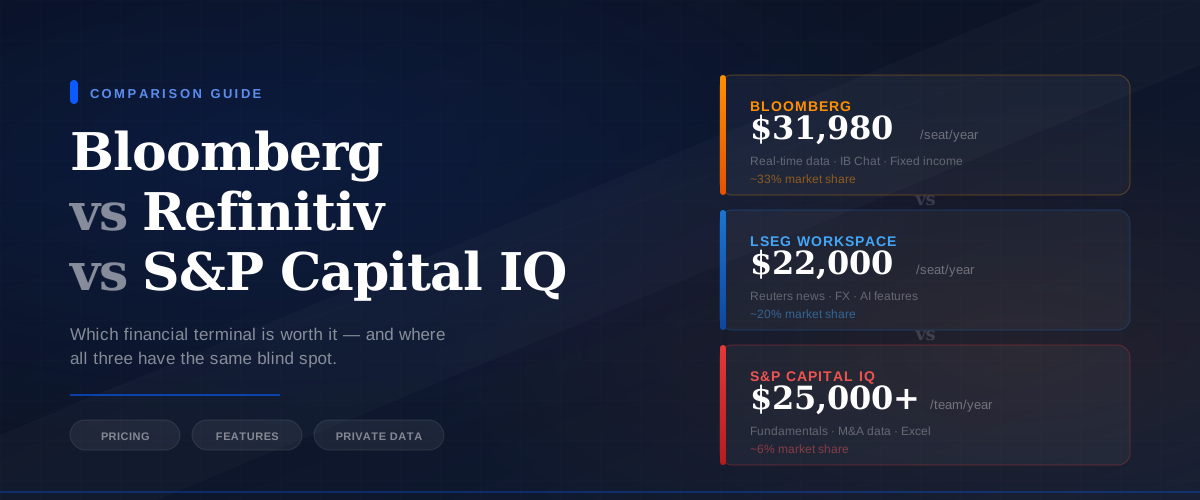
Bloomberg, Refinitiv, and S&P Capital IQ dominate the financial data industry. Together they control roughly 60% of the market. If you work in research, corporate finance, or strategy, you’ve almost certainly used at least one of them.
Each platform costs between $22,000 and $32,000 per year. Each has a clear strength. And each has real blind spots — particularly when it comes to private company financials outside of the US and UK.
This article breaks down all three on pricing, features, and data quality. Then it addresses a question most comparison articles ignore: what do you do when your terminal can’t give you the company data you actually need?
Annual Cost Comparison

Head-to-Head: Feature Comparison
All three platforms try to be a one-stop shop. They’re not. Here’s how they compare on the things that actually matter to research analysts and finance teams:
Feature | Bloomberg | LSEG Workspace | Capital IQ |
Public Company Financials | Excellent | Strong | Excellent |
Private Company Financials | Limited (large PE-backed) | Limited | Good (US/UK focus) |
Corporate Structure / Ownership | Basic | Basic | Good |
Global Coverage Depth | Strong (US/UK/EU focus) | Broad but uneven | US/UK heavy |
Real-Time Market Data | Best in class | Strong | Limited |
Fixed Income | Best in class | Strong | Moderate |
M&A / Transaction Data | Moderate | Moderate | Best in class |
Exclusive News | Bloomberg News | Reuters | S&P Research |
Excel Integration | Add-in | Seamless | Best in class |
API Access | B-PIPE (expensive) | LSEG Data Platform | Available |
Messaging | IB Chat (standard) | — | — |
Learning Curve | Steep | Moderate | Low (web-based) |
Market Share | ~33% | ~20% | ~6% |
Bloomberg Terminal: The Gold Standard — at $32K a Year
Bloomberg commands roughly a third of the global financial data market. For trading desks, portfolio managers, and fixed income analysts, nothing else delivers the same combination of real-time data, analytics, and network effects.
The terminal covers equities, FX, commodities, fixed income, and derivatives — all in real time. Bloomberg News provides exclusive reporting. And IB Chat, Bloomberg’s built-in messaging network, has become the default communication channel for institutional finance. If you’re not on IB, your counterparts can’t reach you.
For company research, Bloomberg handles public company financials well. Standardized financial statements, analyst estimates, peer comparisons, and sector overviews are all fast to pull. The command-line interface is powerful once you’ve invested the time to learn it.
Where Bloomberg falls short
Cost. At $31,980 per single seat (or ~$28,320 per terminal on multi-seat contracts), Bloomberg is the most expensive option by a wide margin — and prices jumped 6.5% for 2025 contracts alone.
Private company data is Bloomberg’s biggest gap. Coverage is largely limited to larger PE-backed companies or firms with some public market touchpoint. Need financials on a mid-market manufacturer in Poland, a logistics company in Brazil, or a tech firm in Southeast Asia? You’ll likely get nothing — or a bare-bones profile with no actual financial data.
The API (B-PIPE) adds significant cost on top of the terminal subscription. And the learning curve is notoriously steep. New users need weeks before they become productive.
Best for
Traders, hedge fund PMs, fixed income desks, and any role where real-time market data and IB Chat are mission-critical. Also strong for public company financial analysis where speed and depth matter. Less useful for private company research or global company data outside core Western markets.
LSEG Workspace (Refinitiv): Bloomberg’s Closest Challenger
After the London Stock Exchange Group’s $27 billion acquisition, Refinitiv Eikon was relaunched as LSEG Workspace. It holds about 20% of the financial data market — the closest anyone has come to challenging Bloomberg’s dominance.
The platform’s biggest selling point is exclusive access to Reuters News. For teams that rely on high-quality financial journalism and real-time alerts, this is significant. LSEG Workspace also excels in FX and fixed income data, and has invested in AI-powered features like LSEG Digest for automated alerts and CodeBook for Python-based analysis directly inside the platform.
Public company financials are solid. The interface is more modern than Bloomberg’s, and the web-based access is a major convenience for teams that don’t want to deal with dedicated hardware.
Where LSEG Workspace falls short
Some datasets are less granular than Bloomberg’s, particularly in fixed income. The post-acquisition integration is still a work in progress — users report inconsistencies between legacy Eikon features and the newer Workspace interface.
At $22,000+ per seat for the full version, you’re approaching Bloomberg pricing territory. A stripped-down version is available at roughly $4,000/year, but it comes with significant feature limitations. Private company coverage is thin, with the same Western-market bias as Bloomberg. And without an equivalent to IB Chat, LSEG Workspace lacks the network effect that keeps many teams locked into Bloomberg.
Best for
Wealth managers, buy-side analysts, and FX-heavy teams who value Reuters news and want a more modern interface than Bloomberg at a slightly lower price point. The entry-level tier works for teams that need basic market data without full terminal capabilities.

S&P Capital IQ: The Research Analyst’s Workhorse
Capital IQ, part of S&P Global, takes a different approach from Bloomberg and LSEG. It’s not built for traders watching live tickers. It’s built for analysts who live inside Excel and need deep fundamentals.
The platform delivers the strongest company financial data of the three — especially for public companies. Standardized financial statements, analyst estimates, M&A transaction data, and screening tools are all best in class. Because it’s entirely web-based, there’s no dedicated hardware requirement. You can access it from any browser.
Capital IQ also has the best private company coverage among the three terminals, though “best” comes with a caveat. Coverage is concentrated in the US and UK. The further you go from those markets, the thinner the data gets. You’ll find profiles for companies in Europe and parts of Asia, but often without the financial detail that makes the data actually useful.
Where Capital IQ falls short
Real-time market data is not what this platform is built for. If your job requires live pricing or trade execution, Capital IQ won’t work. Pricing is flexible (team-based rather than per-seat), but still starts at $25,000+ per team for meaningful access.
The S&P ecosystem creates some lock-in. And while corporate structure data is available, it’s not as deep as what you’d get from providers that source directly from government company registries — especially for emerging markets and smaller jurisdictions.
Best for
Investment bankers, equity researchers, and corporate finance teams who spend their days running comps, building models, and screening deals. The strongest option for public company fundamentals and M&A data. Not ideal for teams that need deep private company data outside of Western markets.
The Blind Spot All Three Terminals Share
Here’s the thing that most terminal comparison articles won’t tell you: all three platforms share the same structural weakness.
They’re excellent at public company data in major Western markets. Bloomberg, LSEG, and Capital IQ all give you solid financials for publicly listed companies in the US, UK, and EU. That’s their bread and butter.
But the moment you need private company financials outside of those core markets, you start hitting walls. Corporate structure and subsidiary mapping for international groups. Beneficial ownership data sourced from official registries. Company data in emerging markets — APAC, LATAM, Africa, Eastern Europe. Verified data with audit trails back to the original government source.
This isn’t a minor gap. There are over 400 million registered companies worldwide. The vast majority are private. Most never appear in Bloomberg, Refinitiv, or Capital IQ. And the ones that do often have incomplete profiles — a company name and address, maybe a sector code, but no actual financials.
The reason is structural. Terminals aggregate data from third-party sources, news feeds, and voluntary disclosures. They’re not set up to pull data directly from the government registries where companies are legally required to file their financial statements.
Your terminal gives you everything you need for Apple, HSBC, or Siemens. But when a deal, a partnership, or a supply chain takes you to a mid-market company in Romania, Indonesia, or Mexico — you’re on your own.
Filling the Gap: What to Look for Beyond Your Terminal
The answer isn’t to replace your terminal. If your team needs real-time market data, Bloomberg News, or M&A screening, those platforms earn their price tag.
The answer is to supplement your terminal with a data source built specifically for the company data that terminals can’t reach. When evaluating providers to fill this gap, these are the criteria that matter:
Criteria | Why It Matters |
Private company financials | Revenue, profit, assets, liabilities — the actual numbers filed with government registries, not just a company name and sector code. |
Data sourcing | Is the data sourced directly from official government registries, or aggregated and resold from third parties? The source determines how trustworthy and current it is. |
Global coverage | Terminals are deep in US/UK. You need a provider that covers private companies across 200+ countries — including the markets where terminals are weakest. |
Corporate structure & ownership | Subsidiary trees, parent companies, and beneficial ownership chains. Essential for understanding who you’re actually doing business with. |
Company news | Latest filings, changes in directorship, registered address updates, and company events sourced from registry data and news feeds. |
API delivery | Clean REST API with solid documentation, so your team can integrate company data into existing workflows, models, and products. |
Audit trails | Can you trace every data point back to its original government filing? Non-negotiable for regulated industries. |
How Global Database Fills the Terminal Blind Spot
Global Database sources company data directly from over 400 government registries worldwide. That means the financials, ownership structures, and corporate details come from the same official sources where companies are legally required to file — not from scraped websites or third-party aggregators.
This matters because in most countries, private companies must file their annual accounts with a government body. Those filings contain revenue, profit/loss, total assets, liabilities, and director information. Terminals don’t tap into most of these registries. Global Database does.
What Global Database covers
Private company financials — revenue, profit, assets, liabilities — sourced from official government filings across 200+ countries.
Public company fundamentals — standardized financial data for listed companies worldwide.
Corporate structure & ownership — subsidiary trees, parent company mapping, and beneficial ownership chains.
Company news & events — director changes, address updates, new filings, and key corporate events.
600+ million company profiles across 200+ countries with audit trails back to the original registry source.
The platform is API-first, which means it integrates directly into your research workflow, CRM, or internal tools. But it’s not trying to replace Bloomberg or Capital IQ. It’s solving the specific problem those terminals can’t: giving you real financial data on private companies around the world, verified at the source.
When to Use What: Decision Framework

Bottom Line
Bloomberg, LSEG Workspace, and S&P Capital IQ each justify their price for the right use case. Bloomberg owns real-time data and the IB Chat network. LSEG Workspace gives you Reuters and a more modern experience at a lower price. Capital IQ is the strongest option for M&A data and public company fundamentals in Excel.
But none of them fully solve the private company problem. When your research, deal flow, or supply chain takes you outside the US/UK public market bubble — and it will — you’ll need a company data source that goes directly to the registry.
The smartest teams don’t choose between a terminal and a company data provider. They use both. The terminal for what it does best. And a registry-sourced platform like Global Database for the company financials, ownership structures, and corporate intelligence that terminals can’t reach.
Frequently Asked Questions
How much does a Bloomberg Terminal cost in 2025?
A single Bloomberg Terminal subscription costs $31,980 per year as of 2025, following a 6.5% price increase. Multi-seat subscriptions are slightly cheaper at approximately $28,320 per terminal per year. Subscriptions are leased on two-year contracts. API access through Bloomberg’s B-PIPE data feed costs extra on top of the terminal subscription.What is the difference between Bloomberg and Refinitiv?
Bloomberg and Refinitiv (now LSEG Workspace) are both financial data terminals, but they serve different strengths. Bloomberg is the market leader with the best real-time data, fixed income analytics, and the IB Chat messaging network. Refinitiv offers exclusive Reuters news, strong FX tools, and a more modern web-based interface at a lower price point (~$22,000/year vs Bloomberg’s ~$32,000/year). Bloomberg has roughly 33% market share compared to Refinitiv’s 20%.Is S&P Capital IQ better than Bloomberg for company research?
For company fundamentals and financial statement analysis, Capital IQ is often considered stronger than Bloomberg. It offers deeper screening tools, best-in-class M&A transaction data, and superior Excel integration. However, Bloomberg is better for real-time market data, fixed income, and news. Capital IQ is also web-based (no dedicated hardware needed) and uses team-based pricing starting at $25,000+, which can be more cost-effective for research teams.Which financial terminal has the best private company data?
Among the three major terminals, S&P Capital IQ has the strongest private company coverage, though it’s concentrated in the US and UK. Bloomberg and Refinitiv have limited private company data, mostly restricted to larger PE-backed firms. For deep private company financials across global markets — especially emerging economies, APAC, LATAM, and Eastern Europe — none of the terminals provide comprehensive coverage. Specialized providers like Global Database fill this gap by sourcing data directly from government registries in 200+ countries.What are the best Bloomberg Terminal alternatives?
The main Bloomberg alternatives are LSEG Workspace (Refinitiv) for a comparable full-featured terminal at a lower price, S&P Capital IQ for deep company fundamentals and M&A data, and FactSet for portfolio analytics and financial modeling. For teams that primarily need company data rather than real-time trading feeds, API-first providers like Global Database offer private and public company financials, corporate structures, and ownership data at a fraction of terminal pricing.Can I get company financial data without a Bloomberg Terminal?
Yes. Bloomberg is essential for real-time market data and trading, but company financial data is available from other sources. S&P Capital IQ and FactSet both provide public company financials. For private company financials — especially outside the US and UK — platforms like Global Database source data directly from 400+ government registries worldwide, covering 600+ million companies across 200+ countries with full audit trails.What is LSEG Workspace and how does it compare to Refinitiv Eikon?
LSEG Workspace is the rebranded version of Refinitiv Eikon, following the London Stock Exchange Group’s $27 billion acquisition of Refinitiv. The platform retains Eikon’s core features — Reuters news, FX and fixed income data, and analytics — while adding AI features like LSEG Digest and CodeBook. Pricing starts at approximately $4,000/year for a stripped-down version, with the full-featured platform costing $22,000+ per seat.How do financial terminals source their company data?
Bloomberg, Refinitiv, and Capital IQ primarily aggregate company data from third-party sources, news feeds, voluntary corporate disclosures, and exchange filings. This works well for public companies in major markets. However, this approach creates gaps in private company data, especially outside the US and UK, because most private companies don’t voluntarily disclose financials. Providers like Global Database take a different approach by sourcing data directly from the government registries where companies are legally required to file.Do I need a financial terminal for corporate structure and ownership data?
Terminals provide basic corporate structure information, but none of the three major platforms offer deep subsidiary mapping or beneficial ownership chains — particularly for companies outside Western markets. If your primary need is understanding corporate hierarchies, parent-subsidiary relationships, and beneficial ownership, a dedicated company data provider that sources from official government registries will give you more comprehensive and verified data than a terminal alone.What is the cheapest way to access financial company data?
LSEG Workspace offers a stripped-down version at roughly $4,000/year for basic market data. Capital IQ’s team-based pricing can reduce per-user costs for larger groups. Free options like EDGAR (US SEC filings) and Yahoo Finance cover basic public company data. For comprehensive private company financials across global markets, API-first providers like Global Database offer subscription and per-call pricing models that scale with usage — typically at a fraction of the cost of a full terminal seat.